
Past Activities
A look at the initiatives that shaped our journey
Over the years, AAECA has initiated and supported a variety of programs that strengthened Austrian–American cooperation in education. These activities reflect our long-standing commitment to teacher training, academic exchange, and the development of new educational ideas.
Seminars & Guest Lectures
Our past seminars brought together experienced educators, researchers, and institutional leaders to share best practices in teaching, curriculum development, and intercultural learning. These sessions laid the foundation for many ongoing collaborations.
International Dialogues
AAECA facilitated academic conversations across borders — including expert discussions on teacher training, diversity, educational reform, and the evolution of modern learning environments in both countries.
Workshops & Collaborative Programs
Workshops focusing on innovation in education, digital tools, and new teaching methodologies helped educators from both nations connect and learn from one another. These events continue to inspire current and future projects.
Legacy & Impact
Even with limited documentation, each past activity represents a step forward in building a stronger educational bridge between Austria and the United States.
This archive will continue to grow as we collect, structure, and modernize the organization’s historical materials.
Our Latest Academic Experiences
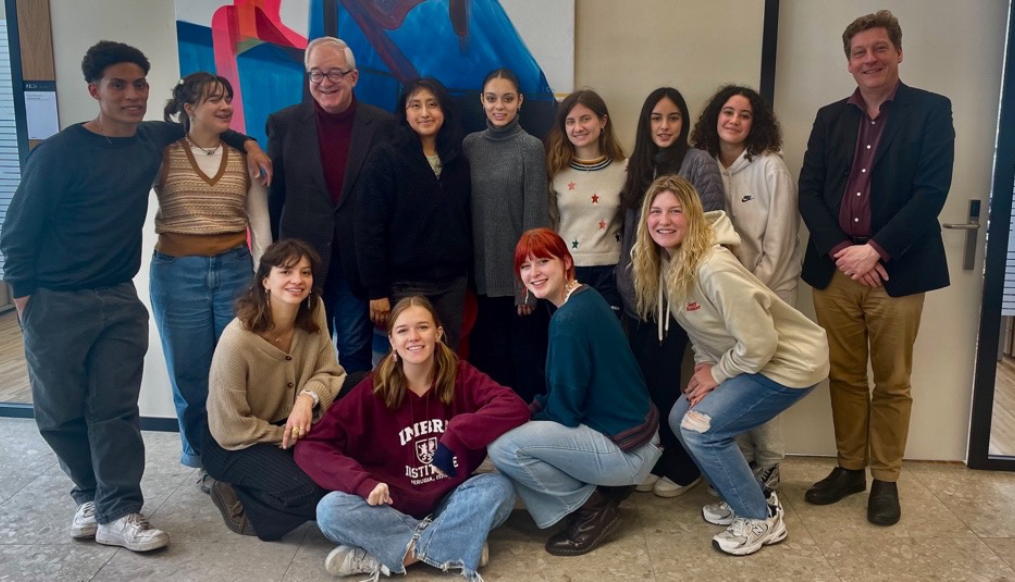
Long Island University / Hochschule Campus Wien
Rainer Braun taught political science at Long Island University in New York and was the European director of the LIU Global Bachelor’s Program.
Braun’s course „European Politics“, held at the Campus Wien University of Applied Sciences (UAS), dealt with the structure of institutions in the EU, the comparison of political systems, and questions of security policy in an applied political science framework.
In addition to “European Politics”, the Campus Wien Academy, the Lifelong Learning Section of the Campus Wien UAS also offered the course „Local Solutions to Global Problems: Societal Challenges“. The topics covered by the lecturers dealt with issues of the European welfare state, particularly in the Austrian context, concerning migration and integration, education and society, and tax policy. These topics were of great interest to the students, especially as they were able to engage with material and in discussions that went beyond an American perspective.
The students also had the opportunity to attend a workshop led by the former European MP Eugen Freund, who worked for many years as a correspondent and bureau chief for the Austrian Broadcasting Corporation in Washington D.C. (1979 – 1984). In addition, they met former Ambassador Gabriele Matzner-Holzer, diplomatic representative of Austria in Slovakia/Bratislava (1997 – 2001), who shared her extensive knowledge as an Austrian diplomat with the students during an excursion to Bratislava.
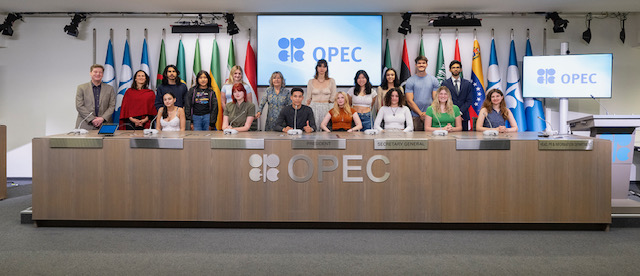
As part of the LIU Global Bachelor’s Program, students visited important international institutions such as the International Institute for Peace (IIP), International Organization of Petroleum Exporting Countries (OPEC), and the Organization for Security and Cooperation in Europe (OSCE). Cultural activities included a visit to the opera, a visit to the Slovakian capital Bratislava, and a visit to the Mauthausen concentration camp, among other outings.
Check out the Global Bachelors Program.
Our Latest Webinar Series
Connecting Continents: A Three-Part Webinar Series
First Webinar
Connecting Continents – European Unification & the EU as a Political Actor
Connecting Continents – Dialogue, Discovery & International Exchange
AAECA × City Tech Webinar Series
The webinar took place on:
📅 February 27, 2026
⏰ 10:00–11:30 AM EST / 16:00 CET
🎤 Opening and Moderation:
Dr. Arthur Mettinger (AAECA)
🎓 Guest Speaker:
Prof. Dr. Johannes Maerk (Hochschule Campus Wien)
Summary
AAECA and City Tech continued the Connecting Continents webinar series with a 90-minute session examining European unification and the European Union as a political actor from a sociological perspective.
After opening remarks, Dr. Arthur Mettinger (AAECA) introduced the session with a short slide presentation explaining how the EU is organized, the roles of its main institutions, and its member and applicant countries. He then moderated an interview with the invited guest speaker, Prof. Dr. Johannes Maerk (Hochschule Campus Wien).
An extended Q&A session led by Dr. David B. Smith (NYC College of Technology) focused on human rights and women’s rights within the EU framework, as well as broader discussions of sovereignty and governance.
Participants explored the EU’s position along a continuum between a confederation and a federal system, noting that while both the European Union and the United States retain forms of national or state autonomy, the balance between union-level and national powers differs.
The Q&A also addressed questions of citizenship, including discussions of jus sanguinis (citizenship based on descent or parentage) and jus soli (citizenship based on place of birth). The discussion examined the increasing complexity of the EU system in the context of rising immigration, following long periods in which immigration was largely in the opposite direction.
The webinar established a sociological foundation for the series, with a more legal and institutional focus planned for the second session.
Dr. Arthur Mettinger
Chairman of the Executive Board
Second Webinar
Connecting Continents – EU Governance in Comparison with the U.S.
Connecting Continents – Dialogue, Discovery & International Exchange
AAECA × City Tech Webinar Series
The webinar took place on:
📅 March 27, 2026
⏰ 10:00–11:30 AM EST / 16:00 CET
🎤 Opening and Moderation:
Dr. Arthur Mettinger (AAECA)
Dr. David B. Smith (NYC College of Technology)
🎓 Guest Speaker:
Prof. Robert Greenawalt (New York City College of Technology)
Mag. Michael Saxl (Austrian Federal Economic Chamber)
Summary
AAECA and City Tech continued the Connecting Continents webinar series with a session examining the governance structures of the European Union and the United States from a comparative legal and institutional perspective.
Following opening remarks by Dr. Arthur Mettinger and Dr. David B. Smith, the webinar focused on how differing historical, political, and legal traditions have shaped governance systems on both sides of the Atlantic. The session featured presentations by Prof. Robert Greenawalt (New York City College of Technology) and Mag. Michael Saxl (Austrian Federal Economic Chamber).
Mag. Michael Saxl introduced the legal and institutional framework of the European Union, emphasizing the role of the Treaty of Lisbon and the distribution of competences across exclusive, shared, and supporting areas of authority. He explained the principle of EU legal supremacy and described the European governance system as a model of “power fusion,” in which authority is continuously negotiated between EU institutions and member states. Particular attention was given to the interconnected roles of the European Commission, the European Parliament, the Council of the European Union, and the European Council.
Prof. Robert Greenawalt provided a comparative perspective on the United States governance system, focusing on the constitutional framework of separation of powers, federalism, and the importance of judicial interpretation within the common law tradition. The discussion highlighted contrasts between the American and European approaches to governance, particularly regarding institutional balance, sovereignty, and legal traditions.
The moderated discussion and extended Q&A session addressed broader questions concerning economic integration, political sovereignty, regulatory harmonization, and the evolving role of member states within supranational structures. Participants also explored how both governance systems respond to changing geopolitical and economic pressures.
The webinar further expanded the series’ progression from sociological foundations toward a more detailed legal and institutional analysis of governance in transatlantic contexts.
Dr. Arthur Mettinger
Chairman of the Executive Board
Third Webinar
Connecting Continents – EU Global Performance vs. the United States
Connecting Continents – Dialogue, Discovery & International Exchange
AAECA × City Tech Webinar Series
The webinar took place on:
📅 May 08, 2026
⏰ 10:00–11:30 AM EST / 16:00 CET
🎤 Opening and Moderation:
Dr. Arthur Mettinger (AAECA)
Prof. Dr. David B. Smith (NYC College of Technology)
🎓 Guest Speaker:
Prof. Dr. Lucas Bernard (New York City College of Technology)
Mag. Michael Saxl (Austrian Federal Economic Chamber)
Summary
AAECA and City Tech continued the Connecting Continents webinar series with a session examining the European Union and the United States in a broader global comparison shaped by international trade, governance models, and geopolitical competition.
Following opening remarks by Dr. Arthur Mettinger and representatives of City Tech, the discussion focused on how global power structures increasingly influence governance, regulation, and economic cooperation. The webinar featured presentations by Prof. Dr. Lucas Bernard (New York City College of Technology) and Mag. Michael Saxl (Austrian Federal Economic Chamber), followed by an extended moderated discussion and audience Q&A led by Prof. Dr. David B. Smith.
Prof. Dr. Lucas Bernard framed the discussion around a triangular relationship between Europe, the United States, and China, arguing that contemporary global analysis can no longer rely solely on a bilateral EU–US perspective. He described Europe as emphasizing institutional coordination, legitimacy, and regulatory harmonization; the United States as prioritizing competition, legal procedure, and strategic flexibility; and China as focusing on state-directed capacity, industrial strategy, and technological integration. Artificial intelligence regulation served as a central example of how these differing governance philosophies shape policy approaches in each region.
Mag. Michael Saxl complemented this perspective with a trade-policy-oriented analysis of the European Union. He emphasized the structural importance of trade within the EU economy and highlighted Europe’s extensive network of preferential trade agreements. His presentation also addressed the European internal market as both a major economic achievement and an ongoing regulatory project, noting that national differences in standards and regulations continue to create practical challenges for integration.
The moderated discussion and Q&A explored broader questions concerning international governance, legal culture, ethics, public responsibility, and the balance between individual liberty and collective coordination. Participants examined how differing political traditions influence regulation, institutional trust, and approaches to global cooperation in times of technological and geopolitical change.
The webinar concluded the current Connecting Continents series by expanding the discussion beyond transatlantic comparison toward a wider global framework for understanding governance, political economy, trade, and technological regulation in an increasingly interconnected world.
Dr. Arthur Mettinger
Chairman of the Executive Board
Previous Webinar
Connecting Continents
Connecting Continents – Dialogue, Discovery & Discourse
AAECA × City Tech Webinar Series
The inaugural webinar of this new collaboration project between AAECA and City Tech – New York City College of Technology (CUNY) will take place on:
📅 November 21, 2025
⏰ 16:15–17:30 CET
🎤 Speaker:
Dr. Marco Castillo (City Tech)
Topic:
“The Constitution of the United States and the Authority of the President”
The webinar will include ample time for questions and open discussion.
For follow-up questions after the event, you may contact Dr. Castillo directly at: MCastillo@citytech.cuny.edu
🔗 Zoom Access
Meeting ID: 826 9518 9255
Passcode: 059768
Join via link:
https://us02web.zoom.us/j/82695189255?pwd=C1uBmZqiPPhDfnlLikWUIm6aFKNUx8.1
If you plan to attend, please notify us at office@aaeca.com.
The webinar will be recorded, and selected parts will later be made available on the AAECA website.
Warm regards,
Dr. Arthur Mettinger
Chairman of the Executive Board